10 Questions to Ask Before You Hire Tutors Online for Your Child
10 Questions to Ask Before You Hire Tutors Online for Your Child
Choosing a tutor for your child is one of those decisions that can seem straightforward until you actually start looking. One tutor has impressive qualifications, another has years of experience, and another promises personalised attention. On paper, several of them may look like a good choice. The real question is whether they will work well for your child.
Before you hire tutors online, take some time to ask about their teaching experience, approach, availability, assessment methods, and experience with your child’s curriculum. You may get very different answers, and those answers can help you understand what to expect once the classes begin. These 10 questions will help you have that conversation before you decide.
List of 10 Questions Parents Should Ask Before They Hire Tutors Online
A tutor’s qualifications can tell you about their background, but they do not tell you how they will teach your child. A better conversation reveals how the tutor thinks about learning: how they identify gaps, respond to a student who is already doing well, explain difficult topics, and decide what needs attention next.
The answers matter just as much as the questions. You are looking for specific examples, a clear teaching approach, and an understanding that two students studying the same subject may need very different support. The questions below can help you find out what you can realistically expect from the tutor once the classes begin.
1. How Do You Find Out What My Child Actually Struggles With?
Parents should ask this because a tutor cannot plan useful lessons without first knowing where the student is having difficulty. A child may be losing marks because they have missed a basic concept, struggle to apply what they know, make repeated calculation errors, or simply need more practice. A tutor who starts teaching straight from the textbook may miss the real issue.
A good answer should include some form of initial assessment or diagnostic discussion, rather than an assumption based only on the child's previous marks. The tutor should be able to explain what they look at, how they identify patterns in mistakes, and how those findings influence the lessons that follow.
2. What Would You Change If My Child Already Performs Well?
Being a high-performing student does not necessarily mean they need more worksheets or harder questions. Parents should ask this to understand whether the tutor can move beyond simply following the syllabus and identify where the student can improve further.
Listen for an answer that talks about challenging the student at the right level. A good tutor may focus on higher-order questions, application, exam strategy, speed, accuracy, or areas where the student has not yet reached their potential. The important thing is that you must hire a tutor online who has a plan to help your child achieve the set academic goals and make lessons useful even when there are no obvious academic gaps to fix.
3. Can You Show Me How You Would Teach a Difficult Concept?
This question gives parents a chance to see the tutor’s teaching style instead of relying on a description such as interactive or student-focused. Someone may know a subject extremely well but still struggle to explain it clearly to a student who does not understand it the first time.
The answer should ideally be specific rather than theoretical. Ask the tutor to choose a concept appropriate to your child’s level and explain how they would approach it. A strong response should show that they can break a complex idea into manageable parts, use examples or alternative explanations when needed, and check whether the child has actually understood it.
4. How Do You Decide What My Child Should Study Next?
This question helps parents understand whether lessons will follow a fixed sequence or change according to the student’s progress. Simply moving from one chapter to the next may not make sense if a child is still struggling with a prerequisite concept or has already mastered the material.
The tutor should be able to explain how they use the student’s performance to plan the next lesson. This could involve classwork, homework, tests, mistakes, questions raised during lessons, or regular progress reviews. The key is that there should be a reason behind what comes next, rather than teaching whatever happens to be next in the textbook.
5. What Happens When My Child Keeps Making the Same Mistake?
Repeated mistakes are often a sign that something underneath the mistake has not been understood. Parents should ask this to find out whether the tutor will simply correct the answer each time or try to understand why the same error keeps happening.
A good answer should show that the tutor looks for the reason behind the pattern. They might revisit a basic concept, change the explanation, use a different example, or give the child a chance to work through similar problems with guidance. If you are looking to hire tutors online, this can also tell you whether the tutor sees mistakes as something to correct quickly or as useful information about how the student is learning.
6. How Do You Make Sure My Child Is Actually Improving Between Sessions?
A child attending classes regularly does not automatically mean they are making progress. Parents should ask this to understand how the tutor knows whether the lessons are working and whether improvements are carrying over from one session to the next.
The tutor should have a clear way of tracking progress, whether through regular assessments, practice work, previous mistakes, test performance, or other measurable indicators. They should also be able to explain what happens when progress is slower than expected. You should not have to rely entirely on a tutor saying that your child is “doing better”; there should be some evidence behind that assessment.
7. How Do You Adapt Your Teaching When One Method Doesn't Work?
Not every child responds to the same explanation. A student may understand a concept through a worked example but struggle with a verbal explanation, or may need to solve a problem themselves before the idea clicks. This is why parents should ask what the tutor does when their usual approach is not getting through.
Look for an answer that shows flexibility rather than a fixed teaching routine. The tutor should be willing to try another explanation, change the type of examples, slow down, increase the level of practice, or use a different way of engaging the student. When you hire a tutor online, you are not just choosing someone who knows the subject; you are choosing someone who needs to respond to how your child learns.
8. How Much of the Session Will My Child Actually Be Doing?
In a one-to-one online tutoring session, it is easy for a student to spend most of the session listening while the tutor does the explaining and problem-solving. Parents should ask this because active participation gives the tutor a much better idea of what the child has understood and what they still need help with.
A good tutor should expect the student to answer questions, solve problems, explain their thinking, and ask doubts during the session, rather than simply follow along. The exact balance will depend on the child and the subject, but there should be meaningful time for the student to think and learn from the session. This is especially important if the goal is to build understanding and independence, not just complete another lesson.
9. How Will You Prepare My Child for Questions They Haven't Seen Before?
Knowing how to solve familiar questions is not the same as knowing how to apply a concept in a new situation. Parents should ask this to understand whether the tutor is teaching their child to recognise patterns and think through problems, rather than simply memorising methods.
A good answer should include application-based practice, unfamiliar problems and opportunities for the child to explain their reasoning. The tutor should be able to show how they gradually move beyond worked examples and encourage the student to decide which concept or approach to use. This is particularly important for students preparing for competitive exams or assessments where questions may test understanding in unfamiliar ways.
10. What Will You Tell Me If My Child Isn't Making Progress?
This may be one of the most important questions to ask before you commit to regular tutoring. Progress does not always happen at the same pace, and parents need to know whether the tutor will communicate openly when something is not working rather than simply continue with the same lessons.
A good tutor should be willing to explain what they have observed, where the difficulty lies, and what they plan to change. They may recommend more practice, a different teaching approach, revisiting earlier concepts, or adjusting the pace. You should also know how and when the tutor will communicate this to you. Honest feedback gives parents a chance to make informed decisions instead of discovering much later that their child has been struggling.
What Answers Should Parents Look for When Hiring Tutors Online?
Asking the right questions is only half the process. The more important part is knowing what a useful answer sounds like. A tutor may say they offer personalised teaching or regularly track progress, but those phrases do not tell you much without a clear explanation of what they actually do.
When you hire tutors online, look for answers that give you something concrete to work with. These are some of the signs that can help you understand whether a tutor has a thoughtful approach to teaching.
1. Specific Examples Instead of Generic Promises
Be cautious of answers built around phrases such as “I provide personalised attention” or “I help students improve.” Ask for an example of what that looks like in an actual lesson. A tutor who can describe how they handled a struggling student, changed an explanation, or adjusted a lesson is giving you far more useful information than one making broad promises.
2. A Clear Approach to Personalised Learning
Personalised learning should mean more than changing the worksheet or moving at a different speed. Look for an explanation of what the tutor changes and why, perhaps the sequence of topics, level of difficulty, amount of practice, or way a concept is explained. The strongest answers connect those changes to something the tutor has observed about the student.
3. Evidence of How Progress Is Measured
“Your child is improving” is difficult to judge without something to compare it against. Ask what the tutor actually uses to measure progress. It could be changes in recurring mistakes, performance on unfamiliar questions, accuracy under time limits, or the ability to explain a concept without help. The method does not need to be complicated; it needs to show what has changed.
4. Willingness to Adapt the Teaching Approach
A tutor should be able to tell you what they do when their first approach fails. Listen for signs that they diagnose the problem rather than simply repeat the same explanation louder or more often. Sometimes the issue is not the concept itself but a missing prerequisite, an unclear question, or a student who has learned a method without understanding why it works.
5. Focus on Independent Problem-Solving
A useful tutor should not become the person your child depends on for every difficult question. Look for answers that include prompting the student to think, asking them to explain their reasoning, giving them time to attempt a problem, and gradually reducing support. The goal is not just getting the right answer during the session, but helping the child reach it independently the next time.

Red Flags to Watch for When Hiring Tutors Online
Not every tutor will teach in exactly the same way, and there is no single formula that guarantees academic improvement. However, some answers should make parents pause and ask a few more questions before committing to regular classes.
Pay attention to what the tutor can actually explain about their teaching process. If the conversation stays focused on promises, fixed routines, or vague claims rather than your child’s learning, that can tell you something important.
1. Promises of Guaranteed Marks or Ranks
Marks depend on several factors, including the student's starting point, effort, attendance, preparation, and the difficulty of the assessment. A tutor who guarantees a particular score or rank is promising an outcome they cannot fully control. A more credible tutor will discuss what they can influence, such as preparation, practice, conceptual understanding, and exam strategy, rather than guarantee a result.
2. The Same Study Plan for Every Student
A fixed curriculum is not necessarily a problem, but a fixed learning plan for every student can be. Two children studying the same syllabus may have completely different gaps, strengths, and learning speeds. Ask whether the tutor can explain what they would change for your child and what would make them change it.
3. Excessive Focus on Completing the Syllabus
Finishing every chapter does not necessarily mean a student is ready to use what they have learned. A tutor who repeatedly focuses on covering more content may leave little time to revisit weak concepts, practise unfamiliar questions, or check whether the student can work independently. Ask how they balance coverage with actual mastery.
4. No Way to Measure Individual Progress
Regular classes alone are not evidence of progress. If a tutor cannot explain how they will know whether your child is improving, it becomes difficult to identify what is working and what needs to change. Look for some method of comparison, recurring mistakes, accuracy, independent attempts, assessment results, or performance on increasingly difficult questions.
5. Tutor Talks More Than the Student Learns
A long explanation can feel productive, but talking for most of the session does not necessarily mean the student is learning. Parents should find out how much time the child spends solving, explaining, questioning, and applying what they have been taught. In a one-to-one class, the tutor has an opportunity to observe the child's thinking directly, so that interaction should not be lost.
6. Vague Answers About How They Handle Learning Gaps
Saying “I will give extra attention” does not explain what happens when a student is missing a foundation. A stronger answer identifies the process: finding the prerequisite gap, checking whether it is actually understood, addressing it, and then returning to the original topic. If a tutor cannot explain what they would do when a student repeatedly struggles, ask for a specific example before making a decision.
Final Checklist Before You Hire Tutors Online
Before you book regular classes, take a moment to look beyond the tutor’s qualifications and hourly rate. The right questions should have given you a clearer idea of how the tutor will assess your child, plan lessons, respond to difficulties, and communicate progress.
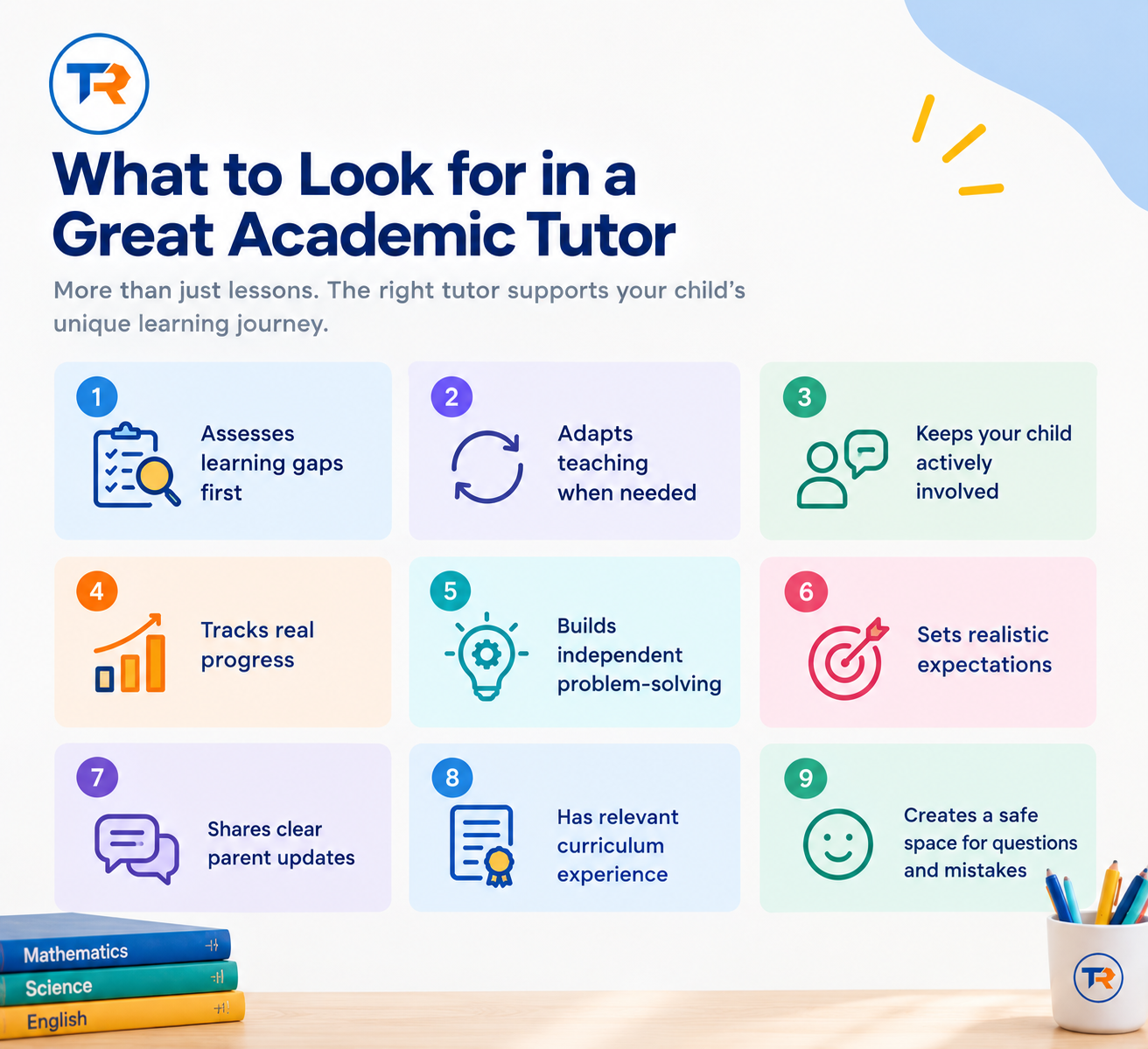
A good tutor should be able to answer these questions clearly without relying on impressive-sounding promises. The goal is not to find a tutor who says everything you want to hear, but one who can explain how they will help your child learn, where they may need support, and how you will know whether the approach is working.
Conclusion
Parents often spend a lot of time comparing tutors before making a choice, but the first few classes can tell you something a profile never will: how your child actually responds to that person. Does your child come out of the class wanting to try the questions alone, or simply relieved that the hour is over? That reaction is worth paying attention to when you hire tutors online. A tutor can look perfect on paper, but the real test is whether your child wants to keep learning with them. If he or she does, you have made the right choice!
Why Parents Choose Top Rank Tutors for Hiring Online Tutors
Top Rank Tutors is an online tutoring platform built for students who need focused, one-to-one academic support rather than a fixed classroom format. Parents can hire online tutors for students in Grades 6 to 12 and competitive exams, with support across both Indian and international curricula. Its academic offerings include CBSE, ICSE, JEE Main, JEE Advanced, NEET and GUJCET, along with IGCSE, IB, A Level, GCSE, AP, SAT and ACT. Students can also receive support in subjects like Mathematics, Physics, Chemistry, Biology, English and Science.
We focus on experienced subject experts, concept-based learning and personalised study plans built around a student's level, goals and learning gaps. Classes are available in one-to-one and small-batch formats, with flexible scheduling for students across different countries and time zones. Parents also receive regular progress updates, while assessments and performance tracking provide a clearer picture of how the student is progressing.
The learning support continues beyond the live class. Depending on the student's preparation, tutoring can include targeted homework, review of completed work, worked examples, past-paper practice, and timed mock tests. This gives students opportunities to apply what they learn instead of limiting their preparation to the class itself.
Parents can also experience the teaching approach before making a commitment. The first class is a free demo that includes a diagnostic assessment, a live lesson, and a personalised learning roadmap, followed by an opportunity for the parent and student to discuss the experience. Classes start at US $8 per hour, with no long lock-in contracts.

FAQs on Hiring Tutors Online
1. Is it safe to hire tutors online from a tutoring platform?
Hiring through an established online tutoring platform can give parents more information about a tutor than finding someone through an informal listing. Parents can review the tutor's qualifications, teaching experience, subjects, and curricula before deciding. It is still sensible to ask about the platform's tutor selection process, class policies, payment terms, etc.
2. Should parents hire an independent tutor or use an online tutoring platform?
An independent tutor can offer direct communication and may suit families that already know who they want to work with. A tutoring platform can make the process more structured by giving parents access to multiple tutors, subjects, curricula, and scheduling options in one place. The practical choice depends on how much support and flexibility the family wants during the selection and tutoring process.
3. Can I hire a tutor from another country for my child?
Yes, online tutoring removes the geographical limitation of traditional tutoring. A tutor based in another country can teach your child as long as they are suitable for the required subject, curriculum, and academic level. Before booking, check their availability, time-zone compatibility, and experience with the curriculum your child follows.
4. Can online tutors teach students in different time zones?
Yes, online classes can be scheduled according to the student's local time rather than the tutor's location. This makes it possible for students to work with tutors based in other countries without needing to change their daily routine. Parents should confirm the tutor's regular availability before starting a fixed schedule.
5. Can one online tutor teach more than one child from the same family?
Yes, depending on the tutor's availability and the children's academic requirements. Siblings can study with the same tutor when they follow the same or related subjects, but they may still need different lesson plans or levels of support. If their academic levels are very different, separate one-to-one sessions may be more suitable.
6. Can I hire a tutor online for short-term exam preparation?
Yes, online tutoring does not have to be a long-term arrangement. A tutor can work with a student for a defined period leading up to a board exam, competitive exam, school assessment, or other important test. When booking, share the exam date and preparation requirements so the tutor can plan the available sessions accordingly.
7. Can I hire an online tutor only for a specific topic or chapter?
Yes, students can seek tutoring for a particular chapter, concept, or area where they need help rather than taking lessons for an entire subject. This can be useful when an exam is approaching or when a student has identified a specific gap. Tell the tutor exactly what the student is struggling with so the available sessions can be focused accordingly.
8. How far in advance should I book an online tutor?
There is no fixed booking period because availability varies by tutor, subject, and time zone. If you need regular classes at specific times or are preparing for an important examination, booking earlier gives you more flexibility when choosing a tutor and schedule. For a short-term requirement, it is worth sharing your deadline when enquiring.
9. What happens if my child misses an online tutoring session?
The outcome depends on the tutoring platform's or tutor's cancellation and rescheduling policy. Some arrangements may allow a missed session to be rescheduled, while others may require advance notice. Parents should check these terms before starting regular classes so they know what happens when an unexpected absence occurs.
10. Can I hire different tutors for different subjects?
Yes, there is no requirement for one tutor to teach every subject your child studies. Using different subject specialists can help when your child needs support across subjects that require very different expertise. Parents should make sure that each tutor understands the child's broader academic schedule so the workload remains manageable.
11. Do online tutoring platforms handle tutor scheduling and communication?
Many platforms provide scheduling and communication support, but the exact services vary between platforms. Some manage class bookings, reminders, tutor-parent communication, and session updates within the platform, while others leave more of this coordination to the tutor. Parents should check what is included before choosing a platform.
12. Can parents speak with the tutor before starting regular classes?
Many online tutoring platforms offer a way to interact with or assess the tutor before committing to regular classes. This may be through an introductory call, consultation, or demo class, depending on the platform. It allows parents and students to discuss academic requirements, teaching expectations, and whether the arrangement feels suitable.
Start your learning journey today
Book a free demo class or explore our courses and pricing.